Switch servers if a stream won't play. Your server and progress are remembered on this device.
 E1
30 min
E1
30 min 1. Logic by Machine
The first program serves as a basic introduction to computers. Dr. Richard C. Hamming, research mathematician at Bell Telephone Laboratories, discusses the computer revolution – “speed, cost and effort favor the computer over the laboratory approach.” Dr. Ernest Nagel, a leading logician and philosopher at Columbia University, talks about the relationship of man and machine and the relationship of the symbolic world of mathematics to the real world of objects and events.
E2
30 min 2. Universe of Numbers
This program is first concerned with the history of computer development from the first mechanical calculator invented by Blaise Pascal in the Seventeenth Century to ENIAC, the first completely electronic calculator built in the mid-1940s by John Mauchly and J. Presper Eckert.
E3
30 min 3. Universal Machine
The computer can be called a “universal machine” in that it is capable of doing whatever man is capable of instructing it to do. Dr. C.R. DeCarlo, director of education for IBM, comments on the fact that the computer revolution represents a fundamentally different kind of advance because, unlike the industrial advances, the computer manipulates and processes information at incredible speeds. Of course, the answers and decisions that man gets from a computer depend entirely upon the data and instruction put into the machine.
E4
30 min 4. The Control Revolution
While the industrial revolution resulted in tools for producing things the control revolution is bringing about the use of a tool (the computer) to control the tools which make things. The development of these information machines or electronic computers has made possible automatic control of routine tasks in government industry, and general business. The programs shows one of the earliest non-scientific applications of computer control – the recording, storing, and processing of vast data handled by the Social Security Administration.
E5
30 min 5. Managers and Models
This program explores the design and simulation capacities of the modern digital computer. The program first visits the Marshall Space Flight Center in Huntsville, Alabama, where Dr. Helmuth Koeltzer, head of the Space Flight Center’s Computation Laboratory, discusses the importance of mathematical models (for example, the translation of a model of a Saturn rocket into numerical terms) and computers in the design and testing of the booster stage of the Saturn Rocket.
E6
30 min 6. Engine at the Door
J. Presper Eckert, co-inventor of ENIAC and vice president of the UNIVAC division of the Sperry Rand Corporation, begins by asking the question, “Will machines ever run man?” Eckert comments, “If we are able to make a machine which is capable of emulating human thinking and is capable of self-reproduction. I hope that the man who does this has the presence of mind to kick the plug out of the socket before he starts running.”
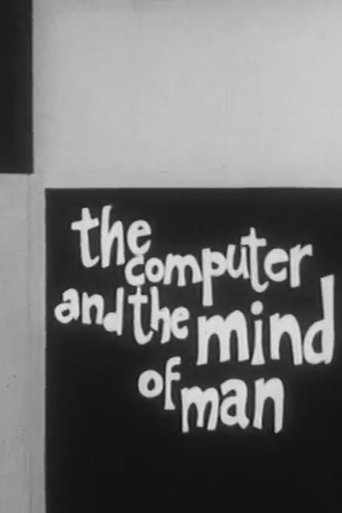
In the 1940s a different kind of tool was invented a tool for extending certain powers of mans mind, the electronic computer. It is the fast, reliable, and tireless performance of a variety of arithmetic and logical operatic is which gives the computer its great utility and power. What this exciting invention means to mankind now and in the future is the subject of this provocative series.
Genres: Documentary
Stars: Dr. Richard Hamming, J. Presper Eckert, Dr. C.R. DeCarlo, Dr. Thomas Burton
 TV
TV
Kylie
2026
 TV
TV
Pee-wee as Himself
2025
 TV
TV
Escaping Twin Flames
2023
 TV
TV
Legacy: The True Story of the LA Lakers
2022
 TV
TV
Earth at Night in Colour
2020
 TV
TV
Down to Earth with Zac Efron
2020
 TV
TV
Prop Culture
2020
 TV
TV
Eli Roth's History of Horror
2018
 TV
TV
Hot Girls Wanted: Turned On
2017
 TV
TV
Mind Field
2017
 TV
TV
The Story of God with Morgan Freeman
2016
 TV
TV
The Circus
2016